The Village Simpleton… and His Follower, the Foolish Philosopher!
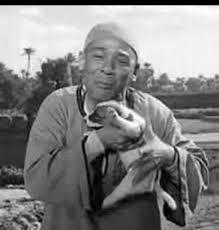
It may occur to the reader that I am speaking here of the famous “village simpleton” of Egyptian drama—that archetype so brilliantly portrayed by great artists, foremost among them the genius Mohamed Tawfiq in the film Hassan and Na‘ima, where he embodied the character of “Ibn Sabiha,” Hassan’s companion (Moharram Fouad) and the lover’s messenger to Na‘ima, a role that ultimately cost him his life as the price of his friendship with Hassan.
This is a figure that drama has consistently presented as mentally disabled: dressed in tattered clothes, eating from the weeds of the earth, wandering aimlessly through the village day and night—save for brief moments when a few families take pity on him, offering him some food and warmth for a few minutes, before he returns once again to his own world.
Or perhaps you imagine that I am speaking of the village dervish, a figure portrayed jointly by drama and literature, and abundantly embodied in reality in our Egyptian villages: a man roaming about in torn clothes, with a thick beard and a heavy stick held by one end, leaning on it at times and brandishing it at children who tease him at others. He sometimes predicts people’s futures: girls ask him about the date of their marriage, women about the sex of the children in their wombs, and pupils and their mothers about exam results. He is occasionally right and often wrong, yet everyone continues to chase him with questions, hoping for a reassuring answer that might soothe the soul, even if only temporarily.
Some of my friends and companions who lived with me for a long time in my beloved city of Minya may think I am speaking of yet another type of “village simpleton,” one we saw with our own eyes and knew in childhood. This person was called “Saad the Simpleton.” Saad was not very different from the dramatic version, except that he was neither a dervish nor mentally disabled, but rather a mixture of the two. He walked the streets in shabby clothes, with a thick beard, holding a stone in his hand. If you approached him, he would wave the stone at you; if you ran past him in fear, he would shout his famous phrase: “Don’t be afraid… I’m just bluffing,” meaning that he would not strike you, only threaten with the stone.
At times, Saad would offer his services to housewives. He would keep watch for the husband’s return from work, then rush to alert the wife—who was often standing on the balcony trying to catch a bit of fresh air, since women’s circumstances in our country, especially during that period of the 1960s, did not allow them to leave the house or even stand on balconies. Saad would warn her of her husband’s imminent arrival, and she would quickly retreat indoors. The next day, she would reward Saad with a plate of lentils, okra, or moussaka, along with a loaf of bread. Saad would be overjoyed and faithfully repeat this service every day.
My friends and I grew up—the group they used to call “the intellectuals of the Agricultural Engineers’ Syndicate” in Minya—and the figure of Saad remained etched in our minds as a vivid embodiment of the “village simpleton.” Yet we soon encountered, in major cities and among intellectual circles, a different kind of village simpleton: the ignorant person who claims knowledge of everything. As the great poet Ahmed Abdel-Mu‘ti Hijazi put it:
“He speaks on every matter, yet scarcely masters any of them or even approaches mastery… It is sheer folly—no judgment and no morals… The Lord of creation gives you a head, and you merely wear it.”
With the expansion of social media platforms and their influence, this character has grown until it dominates the digital space, pursuing people in their sleep and wakefulness—sometimes with analyses, at other times with information found nowhere but in their imagination. Thus, a new concept of the “village simpleton” has taken root, encompassing those who speak with absolute certainty on every subject, including those requiring precise specialization, without possessing even the slightest amount of sound information or rigorous analysis. Joining them are those who clothe their ideologies, or their political or religious ideas, in the garb of certainty, speaking about them in a language of crude outpouring here and there, detached—along with their statements—from the possibilities and details of the surrounding reality. Instead of elevating the mind as a tool for knowledge, they have employed it as an instrument of ignorance, domination, and arrogance.
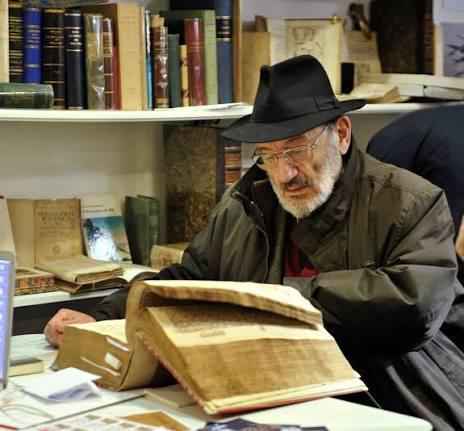
Although Nietzsche and Kant addressed this issue in a fundamental way—Nietzsche through his critique of the sacralization of philosophy, and Kant by establishing a court of reason—the most remarkable observer and analyst of this phenomenon was the renowned Italian philosopher, novelist, and literary critic Umberto Eco, the originator of the famous term “foolish philosophers.” In Eco’s usage, this term is no different from the “village simpleton” I mentioned earlier: they speak in the name of reason while practicing reductive simplification, false certainty, and hollow moral posturing.
More precisely, they speak about everything without deep knowledge, confusing personal opinion with absolute truth—or, as Eco describes them, “self-confident ignorance.” For Eco, the danger lies not in ignorance itself, but in false certainty.
In the age of trends and social-media stars, we are confronted with a flood of these self-assured ignoramuses. They appear before us on every platform, in every group and institution, drafting statement after statement and spinning tale after tale on every conceivable subject, without the slightest grasp of even the most basic real information about what they are discussing. They issue analyses and positions based on their erroneous assumptions, resulting in catastrophic mistakes that harm others before they harm themselves.
They never pause to consider the intellectual foundation of what they utter—or rather, what they spew at us—or the stance they adopt: is it based on genuine information, or on sheer ignorance? And what happens when facts slap them in the face, and they awaken to a catastrophe that radically contradicts all their expectations and assumptions? By then, the great calamity will already have occurred, and there will be no returning to square one; at that point, regret will be of no use.
Yet what is certain is that “Saad”—the one spewing at us from every place and at every time—will not stop, even after discovering the bitter truth, from clutching the stone and shouting at passersby, “Don’t be afraid… I’m just bluffing,” because, in truth, he possesses nothing but empty bluffing that neither nourishes nor substitutes for action.
Strasbourg: 5:00 p.m. Cairo time